
Competitive Intelligence to Community Building: A Q&A with Cindy
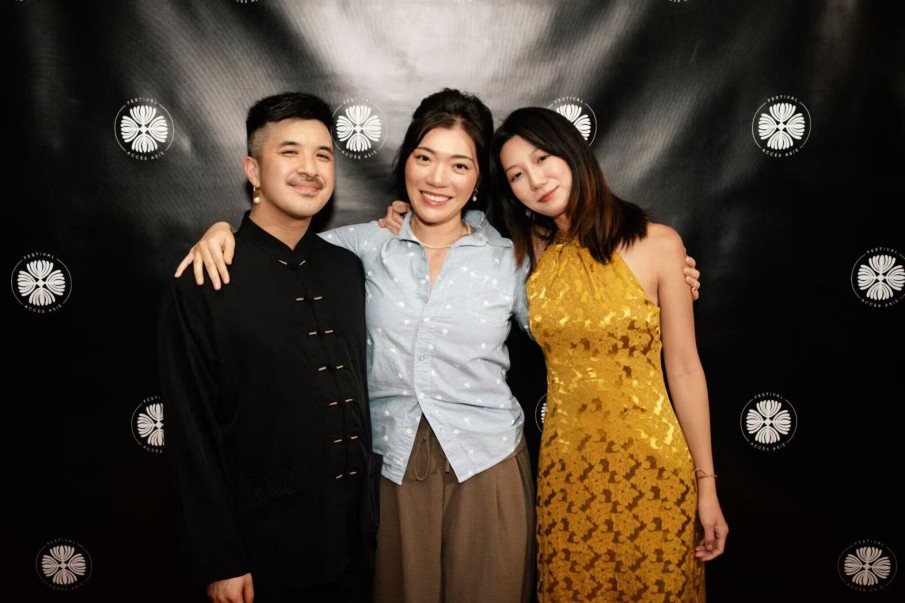
As AAPI Heritage Month comes to a close, we’re spotlighting Cindy, DRW’s Competitive Intelligence Manager and captain of our Asian ERG. In this Q&A, Cindy shares her unconventional path into competitive intelligence, what the work really looks like behind the scenes, and how curiosity continues to shape her career.
She also reflects on the growth of the Asian ERG in its first officially active year — from cross-office programming and cultural events to building a stronger sense of connection and community across DRW.
What led you to a career in competitive intelligence, and how did your path bring you to DRW and your current role?
If you'd asked me in university, I would have told you I was going to be an accountant. That's what I trained in, and I don't regret a minute of it. It taught me the discipline I still rely on every day, precision, patience, and the habit of taking something messy and making it make sense.
But even back then, the part of my brain that lit up most wasn't the ledger. I've always been drawn to questions that don't have an obvious answer. The same instinct shows up in how I like to work: take things apart to understand them, then build something that does the job better. That mix is what eventually led me to research-driven work: starting in Business Intelligence before transitioning into a role within NX focused specifically on Competitive Intelligence.
Today I lead the Competitive Intelligence team at DRW. Our job is to make sure the firm is not caught off guard. Our home and primary stakeholder is NX, the group inside DRW that builds and maintains the ultra-low-latency network infrastructure connecting major trading venues around the world, where small advantages in speed can translate into meaningful competitive edge. For NX, CI acts as an early-warning system: we watch the landscape around the global networks. This can include anything from network builds, regulatory activities to conducting due diligence on potential partners, vendors, and competitors. All of it feeds into decisions that shape the network.
What does Competitive Intelligence look like in your role?
It's a lot less James Bond than people imagine. The part that surprises people most is how much of the work is spent finding the sources in the first place. A big piece of what we do is asking "Where might this information even live?" Our work is unique enough that there isn't an off-the-shelf playbook we can borrow from. We operate in a world where we don't know what we don't know, which means we have to be creative about where we look. Thinking outside the box is the actual craft.
We start by setting a research direction. From there we go looking for sources that can answer it. Once we know where the information lives, we have to figure out how to collect it reliably, how to monitor it for change, and how to sift the signal. We spend a good amount of time building systems. The goal is to turn a creative hunch into a repeatable pipeline, so the team can spend its energy on the harder, more interpretive work. And then we filter; most of what comes through doesn't matter, and our job is to pull out the few pieces that do.
The value of the work shows up in two ways. Sometimes it's immediate: something we surface in the morning changes a decision someone is making that afternoon, whether the news is good or bad. And sometimes it's longer-lived: building a knowledge base that the stakeholders can lean on later.
How do you decide what information is actually worth paying attention to vs. noise?
I think of it as a funnel.
The first gate is relevance: does this touch our business or the places we operate? Most of the world's information fails this test, and we move on quickly. But relevance alone is not enough. Most relevant information is still noise. The narrower test is impact: does this change something we plan, build or prioritize, or does it strengthen the knowledge base we'll lean on the next time a decision comes up? Anything that does one of these two things earns our time.
How do you continue learning and growing in your role?
The industry we operate in doesn't really let us stand still. Markets evolve, regulations shift, technology keeps reshaping what's possible, and on top of that, the we-don't-know-what-we-don't-know nature of the work means there is always another corner waiting to be looked into. A lot of the growth comes from staying closely tuned to the industry: reading widely, following news, and getting exposure to new technologies as they emerge. Beyond that, the work itself teaches me. Because there is no template to follow, I'm constantly pushing into unfamiliar places such as new sources, new tools, and new angles.
The other big source is the people around me. Our colleagues/partner teams are remarkably generous with their expertise, and a lot of what I've learnt has come from them. That's not a small thing.
I don't think curiosity has a finish line, and I'm grateful for that.
What did you hope to create or change when you became captain of the Asian ERG?
When I became the captain of the Asian ERG, I hoped, and still hope, to help turn the community into something more visible, connected, and intentional.
The group already has a strong sense of warmth, with people connecting through shared meals, cultural traditions, and everyday moments together. I wanted to build on that and help create a space where those moments could become more structured and more visible across the firm, especially since this is the first year the ERG has been officially active.
For me, that structure matters.
Without an ERG, these moments can remain scattered. With an official group, we can turn that energy into something more intentional that includes programming, partnerships, conversations, and moments that invite more people to participate.
One thing we have been very intentional about is designing programming across multiple offices. I didn't want the ERG to feel centered around one location only. I wanted colleagues in different offices to feel that they could participate, contribute, and see themselves reflected in the community. That's why we started thinking in terms of cross-office programming and quarterly anchor themes, so the ERG could have a clearer rhythm, a shared direction, and moments that bring people together throughout the year.
Of course, none of this happens through one person alone. It has been a group effort across our committee members, partners in Workplace and Communications, and colleagues in different offices.
To me, the Asian ERG is part of the firm's broader commitment to inclusion and belonging, but in a very practical and human way. The goal is to create a place where people can connect beyond their day-to-day work, and where culture could feel thoughtful, welcoming, and real.
We also wanted the ERG to be open and accessible, not only for Asian colleagues, but for anyone who is curious, supportive, or simply wants to participate.
What's been an initiative or moment in the Asian ERG that you're especially proud of?
What I'm proudest is seeing the Asian ERG, in its first year of being officially active, take shape as something with rhythm, reach, and purpose.
We started the year with Lunar New Year programming and carried that momentum into AAPI Heritage Month, with food, tea, Mahjong, small cultural experiences that invite people to gather, participate, and learn in a very natural way. The programming has run across Montreal, London, and Chicago, so colleagues in different offices can see themselves in the community we're building together.
We are also starting to build connections beyond the office. This year, we are supporting Festival Accès Asie in Montreal and the Chicago Dragon Boat Race for Literacy, small but real steps into the wider cultural and community life around us.
I want to be honest that none of this is mine alone. I'm genuinely grateful to my committee and to all the colleagues across offices who showed up to build it with us.
In a short period of time, the ERG has gone from informal connection to programming across offices, from internal celebration to external partnership, and from scattered ideas to something people can recognize, join, and help build. That feels like a strong beginning.